Is Tsukiji Outer Market Free To Enter?
Yes, the Tsukiji Outer Market lanes are free to walk. Here is exactly what that free entry covers, what still costs money, and the December request the official market makes of sightseers.
In Short
Yes. Tsukiji Outer Market is free to enter and free to walk: there is no gate, no ticket and no admission charge of any kind. Everything you buy inside, from grilled seafood to knives to tea, is paid for at the stall. The market's official site asks visitors not to eat while walking, and in December it asks sightseers and group tours to stay away during the New Year shopping rush.
This question sits inside the Tsukiji Outer Market guide, which covers the whole market in depth. This post answers the single question of what free entry actually means here.
Quick Facts
| Question | Answer |
|---|---|
| Is entry free? | Yes, the lanes are free to walk, no ticket or gate |
| What costs money? | All food, drink, knives and souvenirs at the stalls |
| Official etiquette rule | No eating while walking, per the official site |
| December request | Sightseers and group tours asked to stay away during the New Year rush |
| Nearest free guided walk | Tsukiji Street Food, 1h 30m, meets at Tsukiji Hongan-ji, on GuruWalk |
| Nearby paid garden | Hama-rikyu, JPY 300, closed 29 December to 1 January |
Is Tsukiji Outer Market Free To Enter?
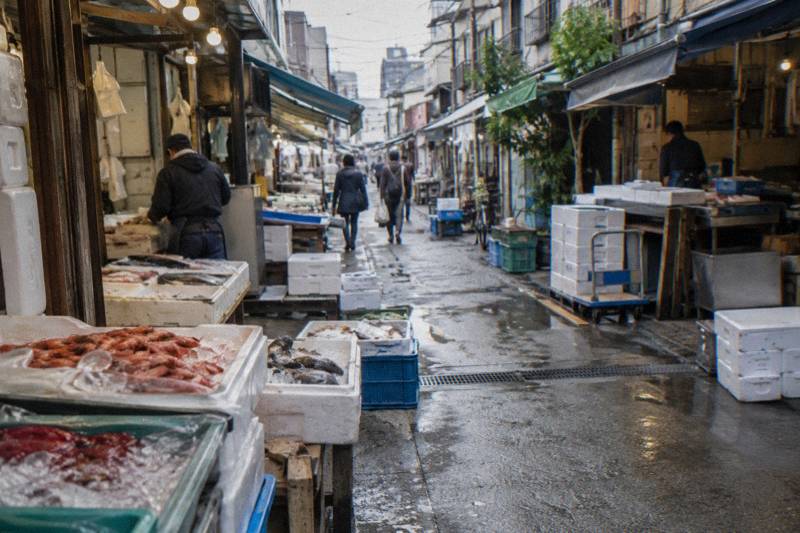
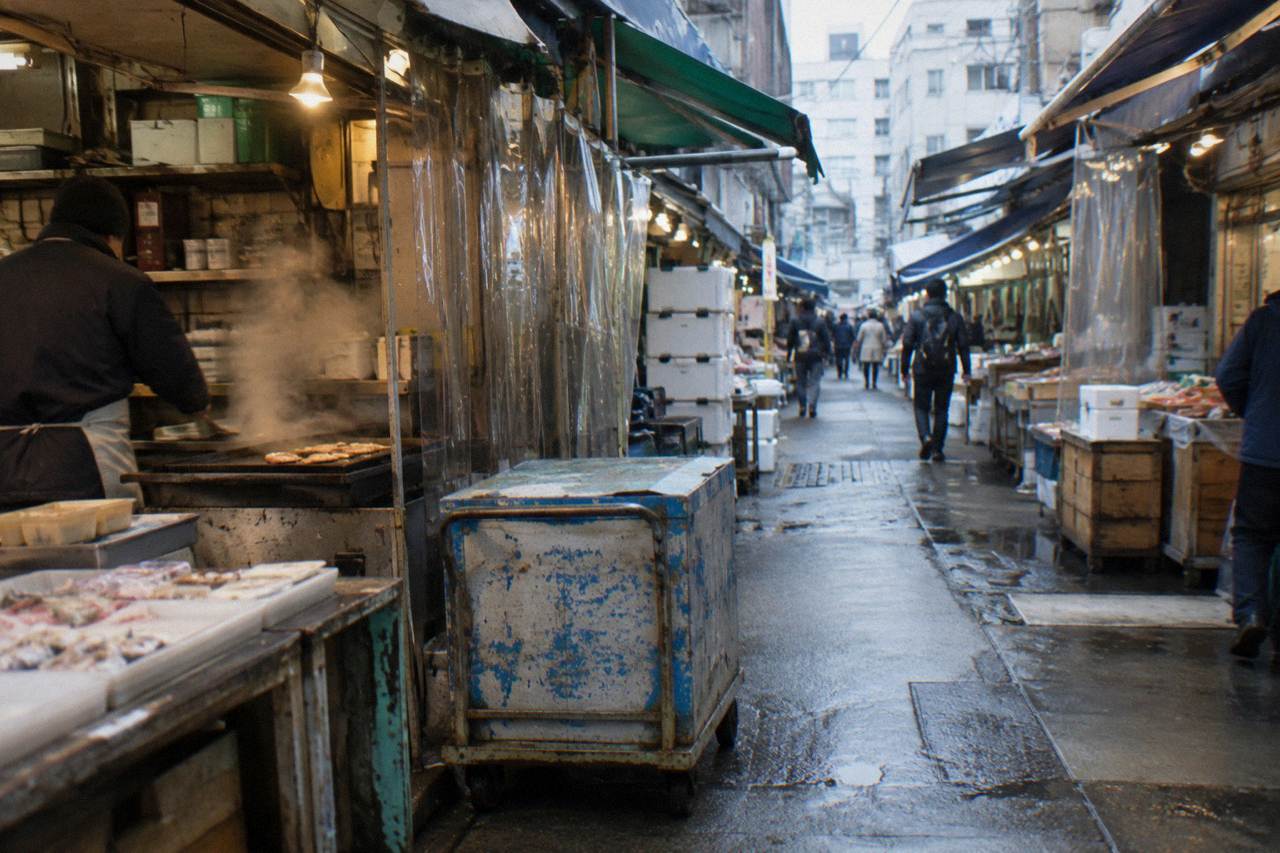
Yes, Tsukiji Outer Market is completely free to enter. There is no gate, no ticket booth, no admission fee and no reservation of any kind for walking the lanes. The market is a working shopping street made of ordinary retail rows, and public streets do not charge admission. Everything changes only when you buy something, because every stall, shop and restaurant inside charges for what it sells.
That single distinction, free entry versus paid purchases, is the whole answer, but it is worth unfolding because the market's history makes people expect something more complicated. The wholesale function left, the retail streets stayed, and a retail street has no entry price.
The word "free" still needs one honest qualifier. Free entry buys you the walk, the smells, the spectacle of vendors working and the street itself. It does not buy you a taste of anything. A common visitor mistake is arriving with the mental model of a festival or a food court with samples, where wandering and grazing blur together. Tsukiji's stalls sell, they do not sample, and the free experience is watching and walking rather than eating.
| Place | Free Or Ticketed | What Is Free | What You Still Pay For |
|---|---|---|---|
| Tsukiji Outer Market | Free | Walking the lanes is free. | Food and shopping are paid. |
The market's own official site adds two requests that shape how a free visit works in practice, and both are published on its English pages. The first is a behaviour rule that applies every day of the year: visitors are asked not to eat while walking in the lanes. The second is seasonal: in December, the official site asks sightseers and group tours to stay away entirely during the New Year shopping rush, because that month is the market's heaviest trading period and the lanes fill with commercial buyers and local shoppers. A free place can still set conditions on how it is enjoyed, and Tsukiji publishes both of its conditions openly.
If you want the lanes explained rather than merely walked, there is a guided option that keeps the visit free in the same pay what you want sense. The Tsukiji Street Food, 1h 30m walk, listed on GuruWalk, meets at the steps of Tsukiji Hongan-ji and covers the market and its food culture with a local guide. The guiding itself is free, pay what you want; whatever you choose to eat along the way is bought separately at the stalls. This site, Free Things To Do In Tokyo, is not affiliated with GuruWalk or with any guide, it simply tracks these listings.
“Kenny was the absolute best. Kindly helped us late when we were running late and gave us a highly entertaining and informative experience. Thank you Kenny!”
Heide, GuruWalk review of Tsukiji Street Food, 1h 30m
That walk is one of several free, pay what you want tours on this site's roster that touch the market or the districts around it, and the trio below pairs the Tsukiji options with palace and Asakusa walks for readers building a fuller free day in the city.
What Does The Free Part Include?
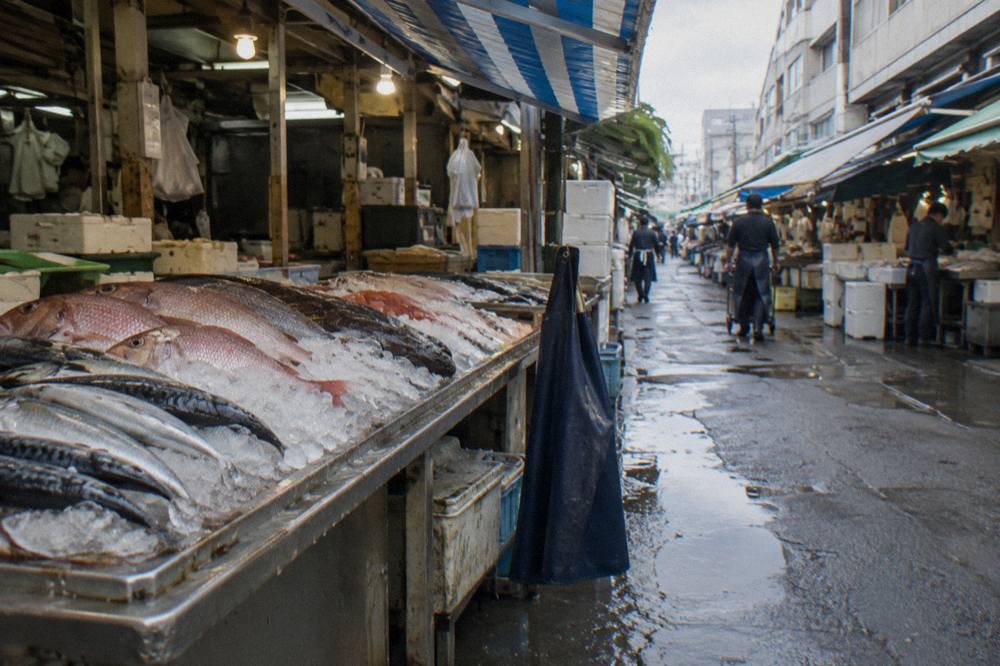
The free part includes walking every lane of the Outer Market, looking at the stalls, watching vendors work, and standing in a district that has been a food trading centre for generations. Photography from the street costs nothing. So does browsing the knife shops, the tea sellers and the pottery stalls without buying. The free experience is the street life itself, and it is genuinely rich.
Be concrete about what that means. The Outer Market is a compact grid, and the free visitor gets all of it: the rows where vendors lay out fish and shellfish on ice, the counters where tamagoyaki is grilled, the shopfronts of the knife retailers whose workshops sit behind the retail space, and the smaller lanes where ceramics, lacquerware and dried goods are sold. None of it sits behind a barrier. The streets are public in the ordinary way shopping streets are public, which is exactly why there is no ticket and never has been.
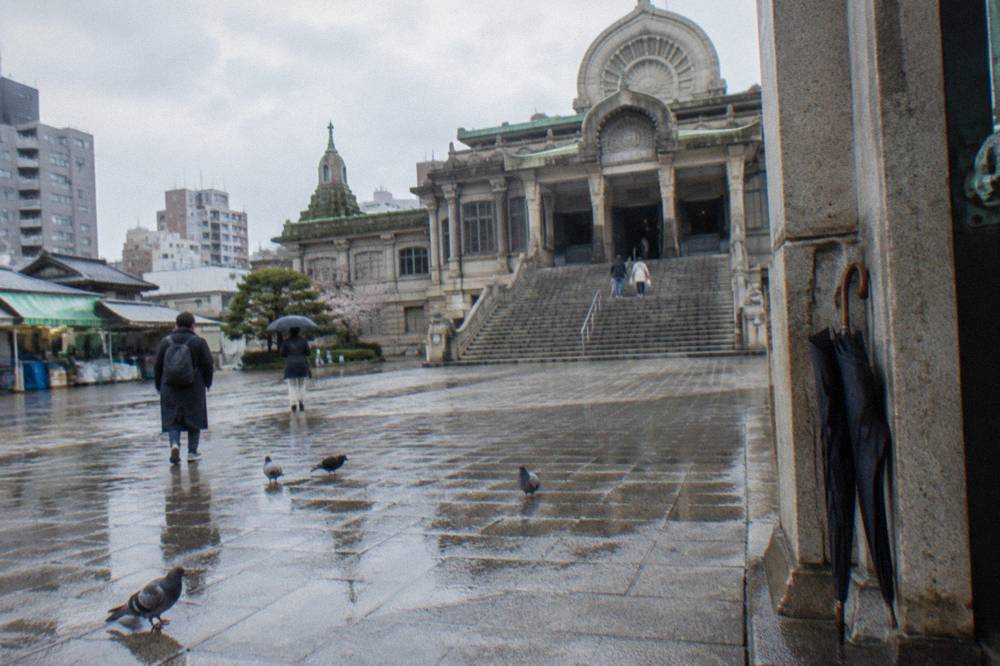
Tsukiji Hongan-ji, the large temple whose steps serve as the meeting point for the market's guided walk, stands at the edge of the market and its precinct is free to enter. The temple's architecture is striking and its forecourt is a calm counterpoint to the lanes. The block around the market also carries the atmosphere of an older commercial Tokyo, with narrow frontages and hand painted signs, and simply walking the surrounding streets is free in the same unregulated way.
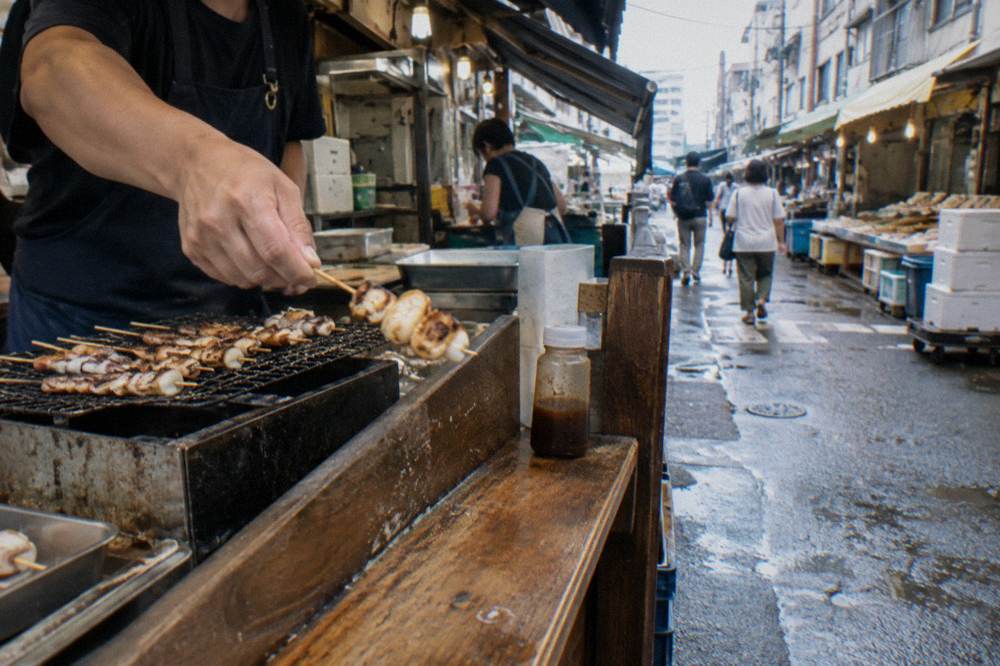
What the free part does not include deserves its own clear statement, because the boundary is where disappointment happens. Watching a vendor grill scallops is free. Eating the scallops is not. Watching a knife seller demonstrate a blade is free. Taking the knife home is not. The market is a place of commerce, and its free pleasures are visual and atmospheric, not edible. Visitors who want to taste the market should budget for it as a food stop, not treat it as a free buffet with a view.
The etiquette rule from the official site shapes the free walk too, so repeat it in practical terms: the market's official site asks visitors to refrain from eating while walking. In practice that means eating at the stall where you bought the food, at a standing spot the vendor indicates, or at one of the small seating areas, and then moving on. Respecting it costs nothing and keeps the free visit welcome.
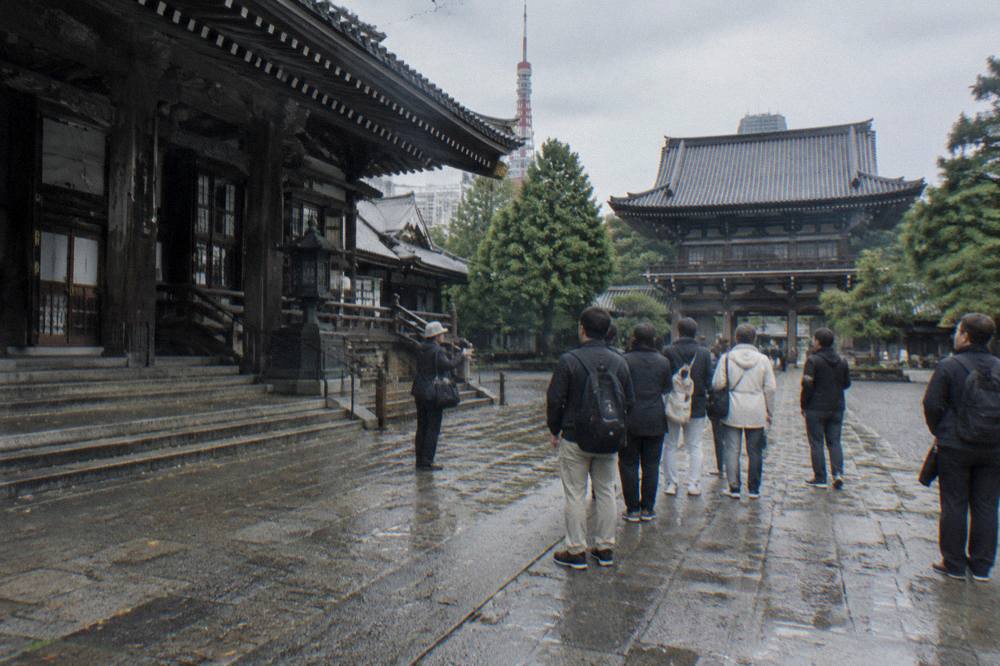
One more free layer is worth naming: the guided walks. The market's best known free tour, the Tsukiji Street Food walk on GuruWalk, is free in the pay what you want sense, meaning the guiding carries no fixed price and you pay the guide what you feel the walk was worth at the end. The food on that walk, like the food on any visit, is bought separately at the stalls.
What Do You Still Have To Pay For?
Everything you consume or carry away is paid: food and drink at every stall, knives and kitchenware, tea, ceramics, souvenirs, and any restaurant meal in the market's sit down eateries. Nearby paid attractions include the Hama-rikyu garden at JPY 300 per adult. No walk on this site's roster charges a fee, but a guide's pay what you want amount is a real cost to plan for.
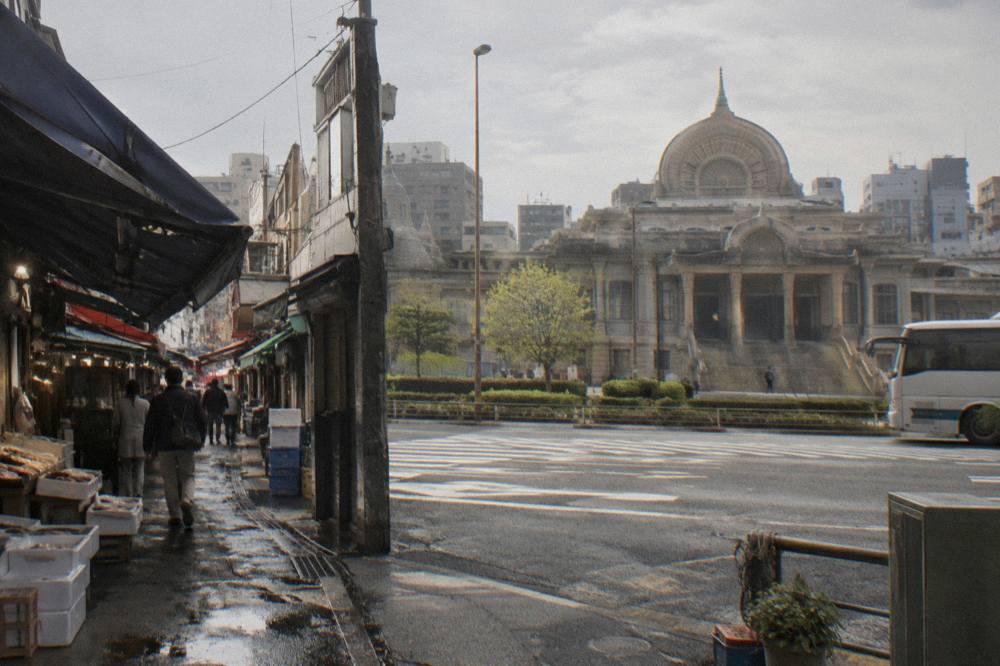
Treat food as the market's headline expense: the lanes are free to walk, but food and shopping are paid. Prices at individual stalls are set by the vendors, change with the season and the catch, and are not published centrally, so the stall itself is where you find the current price. What can be said firmly is the structure: you pay per item at the point of sale, cash remains widely used in these lanes, and a tasting walk through the market is a normal, legitimate spend rather than a hidden fee. Visitors who arrive intending to eat should simply expect to pay stall prices and check each board.
The retail side follows the same logic. Tsukiji's knife shops sell professional Japanese kitchen knives at prices that reflect real craftsmanship, and the same shops sell smaller items like ceramic sharpeners and kitchen tools. Tea sellers, pottery stalls and dried food vendors fill the rest of the retail spectrum. Browsing is free, buying is a transaction like any other, and none of it is bundled with entry because there is no entry to bundle it with.
| Item or activity | Free or paid | Notes |
|---|---|---|
| Walking the market lanes | Free | No gate, no ticket |
| Tsukiji Hongan-ji precinct | Free | Temple at the market's edge |
| Watching vendors and browsing stalls | Free | Photography from the street is free |
| Food and drink from stalls | Paid | Stall prices, eat where you buy |
| Knives, tea, ceramics, souvenirs | Paid | Retail purchases |
| Guided street food walk | Free, pay what you want | Food bought separately |
| Hama-rikyu garden nearby | Paid, JPY 300 | Closed 29 December to 1 January |
The garden line in that table deserves a sentence of its own, because a free walk and a paid garden sit close together here. The Spanish language Tsukiji To Hamarikyu, 3 Hours walk, listed on GuruWalk and rated 4.93 out of 5 across 449 GuruWalk reviews, is itself free on a pay what you want basis, but the Hama-rikyu garden it reaches charges JPY 300 per adult, per the Tokyo Metropolitan Park Association. The guiding is free, the garden is not, and that split should be in your head before you join.
Restaurant meals are the other paid layer. The market and its edges hold small sushi restaurants and sit down eateries, and these are ordinary restaurants with ordinary bills. Anyone mixing Tsukiji's lanes with a Toyosu auction morning should plan them as two separate free visits with paid food at each.
When Is The Free Option Available?
The lanes are a public shopping street, so they can be walked whenever the shops are trading, and the free visit needs no booking. Two timing facts matter: stalls trade in the daytime, and in December the official market asks sightseers and group tours to stay away during the New Year shopping rush. The December request is published on the official site and should shape any winter visit.
Unpack the December point, because it is unusual and easy to miss. Japanese households buy a large share of their New Year food in advance, and the lanes fill with wholesale and retail customers doing serious shopping.
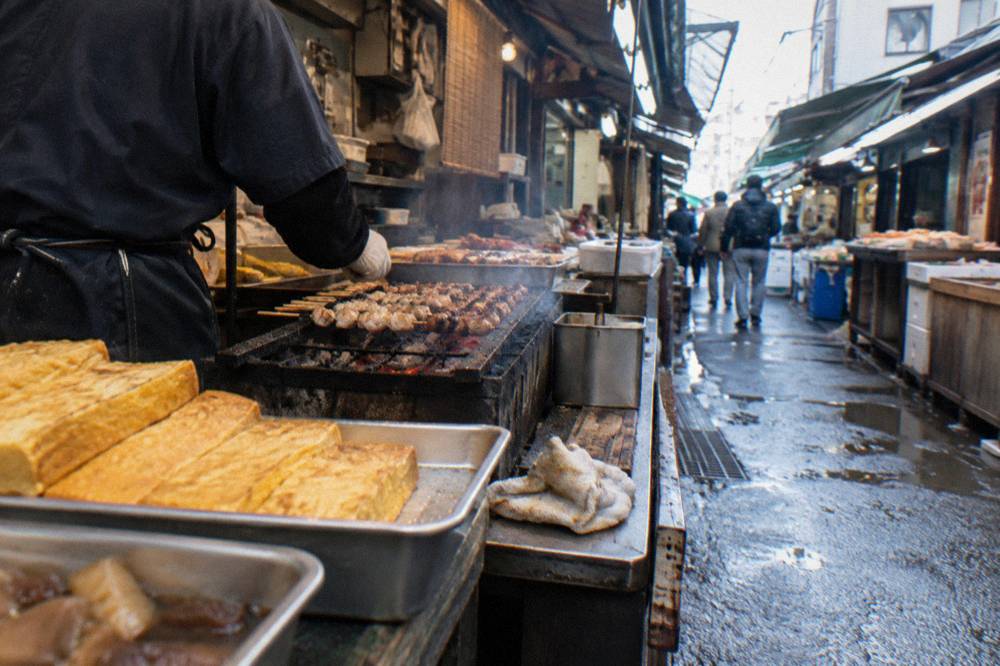
That December request also connects to the free guided walks. A responsible tour schedule avoids the market in December, and a visitor planning independently should apply the same logic to themselves. The surrounding season in Tokyo is otherwise generous: the Marunouchi Illumination runs 12 November to 25 December 2026 along Naka-dori and is free to view from the street, and the Tori-no-ichi festival at Otori Shrine holds its second 2026 day on 19 November, with entry not ticketed and lucky rakes and food paid. Both are free to view and both sit elsewhere in the city, which makes them good substitutes in a December plan that leaves Tsukiji to its shoppers.
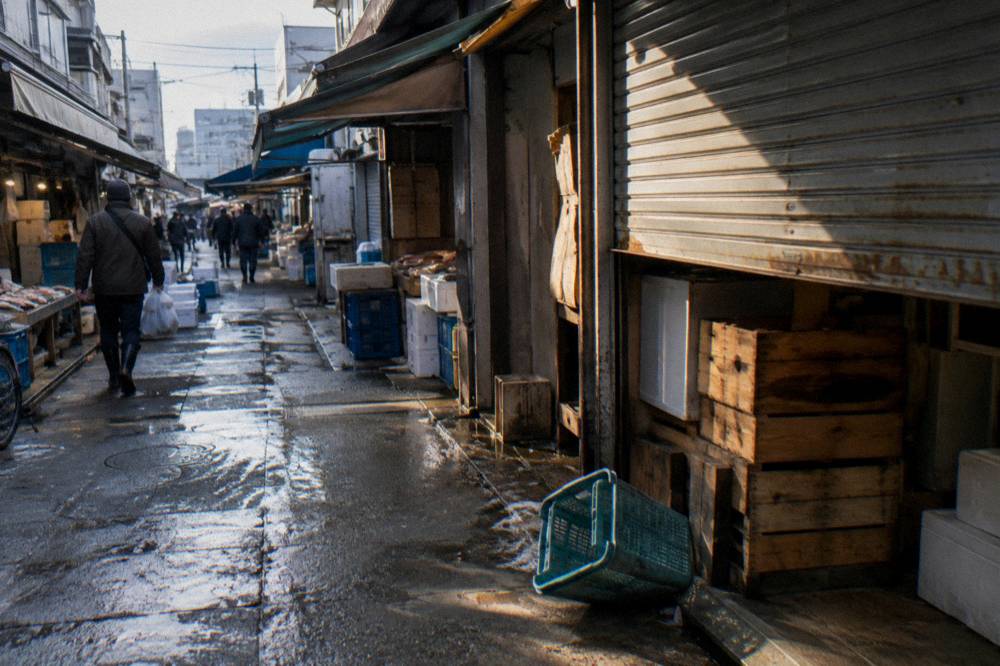
Beyond that, the practical timing of a free visit follows the shops. A street of small vendors is lively when the vendors are working and quiet when they are not, so a free walk is worth most when the stalls are trading, and worth planning around rather than turning up blind. Individual stall hours are not published in one place, so check rather than assume.
| Place | Free Or Ticketed | What Is Free | What You Still Pay For |
|---|---|---|---|
| Hama-rikyu Gardens | Paid | Ticketed metropolitan garden. | JPY 300 adult, JPY 150 over 65; primary school children and younger free; closed 29 December to 1 January. |
Winter also changes the neighbouring paid pieces in ways worth knowing for a combined day. The Hama-rikyu, Koishikawa Korakuen and Rikugien gardens all charge JPY 300 and all close 29 December to 1 January, so the garden finish to a Tsukiji walk disappears over the New Year itself. Rikugien's paid night viewing, 25 November to 6 December 2026, is a separate evening option with its own ticket. None of this affects the market lanes, which remain free regardless, but a December or January plan should expect closures at the edges.
Where Does The Free Visit Start?
There is no formal starting point, because there is no gate, but the practical anchor is Tsukiji Hongan-ji, the large temple at the market's edge whose steps are the stated meeting point of the market's guided walk. Arriving at the temple puts you at the boundary of the lanes with a free precinct to see first. From there the market's grid spreads out on foot.
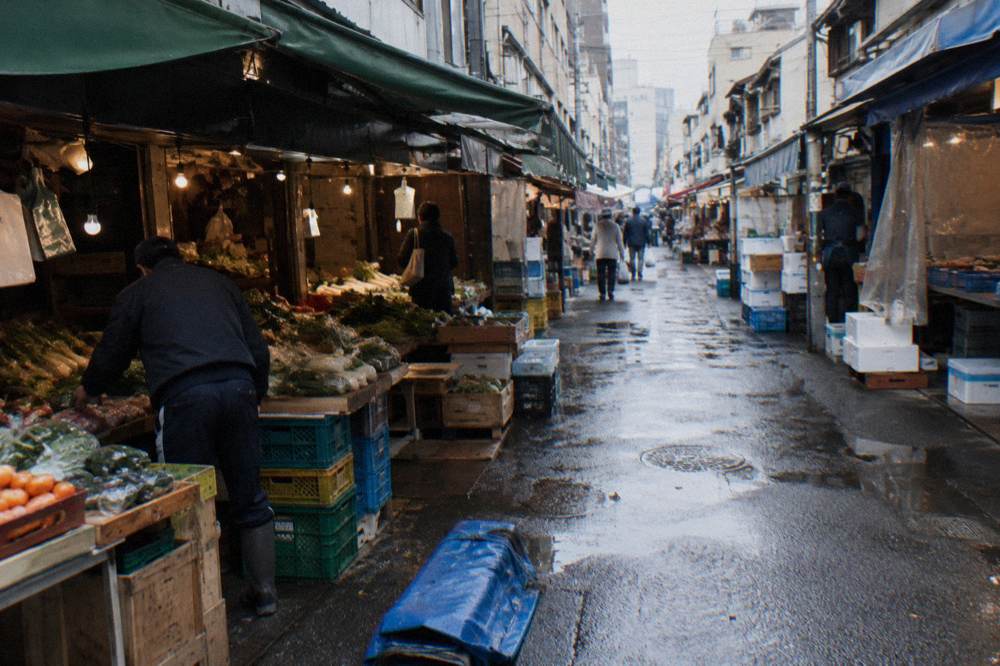
Meeting points matter here mainly because the free walks publish them, and they double as sensible entry anchors for independent visitors. The Tsukiji Street Food walk, 1 hour 30 minutes, English, rated 4.88 out of 5 across 583 GuruWalk reviews, meets at Tsukiji Hongan-ji, at the stairs. The Spanish language Tsukiji To Hamarikyu, 3 Hours walk meets simply at Tsukiji. The bilingual Tsukiji Sushi History walk, with 10 GuruWalk reviews so far, too few for an overall score yet, meets at Kachidoki Station, Exit A1, on the market's far side. Each point touches a different corner of the district, which tells you something about how compact the whole area is.
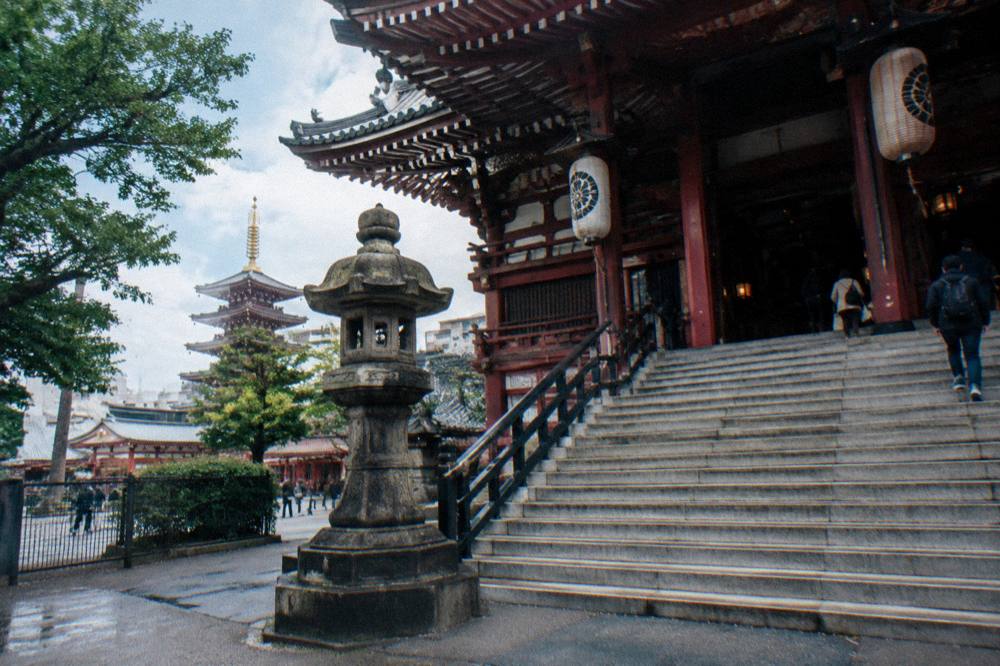
Starting at Tsukiji Hongan-ji has a second advantage beyond geography: the temple precinct itself is free, so the first thing a free visit delivers is a major temple rather than a shopfront. The temple's scale and its dark timber frontage make it one of the more distinctive religious buildings in central Tokyo, and its position hard against the market makes the pairing natural. A visitor who starts there, walks the lanes, and finishes along the water has assembled a substantial free morning without buying anything.
For anyone joining a guided walk rather than going alone, the meeting point discipline is the only logistics that matters. The walks are reserved through their listings, the guide meets the group at the stated spot, and the free, pay what you want arrangement starts at that point. The roster publishes each walk's meeting point exactly, so there is no need to reconstruct directions from scratch.
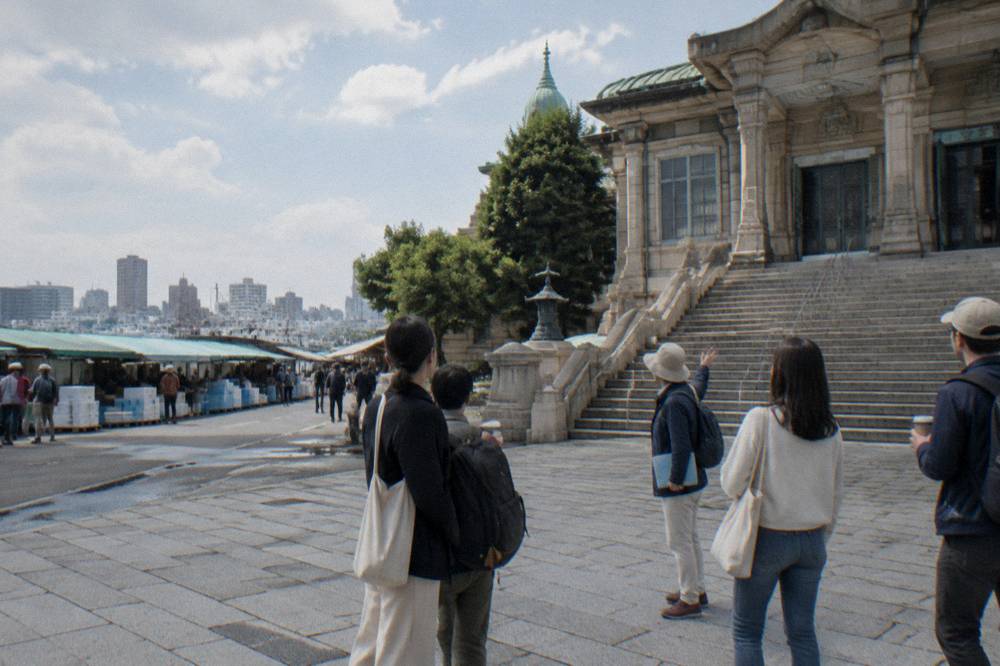
The rest of the district rewards aimlessness, which is itself free. The lanes around the market proper hold smaller shops, coffee stands and the quieter streets of the old merchant quarter, and walking them costs nothing and needs no plan. This is also where the free and paid layers sit closest together: one street over from a free temple precinct is a paid garden gate, and one lane into the market is a stall that expects payment. Keeping those two zones straight in your head is the whole skill of visiting Tsukiji cheaply.
Which Free Walking Tours Cover This?
Several free, pay what you want walks on this site's roster touch Tsukiji's ground or pair naturally with it. The Tsukiji Street Food walk meets at Tsukiji Hongan-ji, the Spanish language Tsukiji To Hamarikyu walk starts in the district, and the Palace Walk Ending At Tsukiji finishes there after starting at the Imperial Palace. All are free, pay what you want, and all run on GuruWalk.
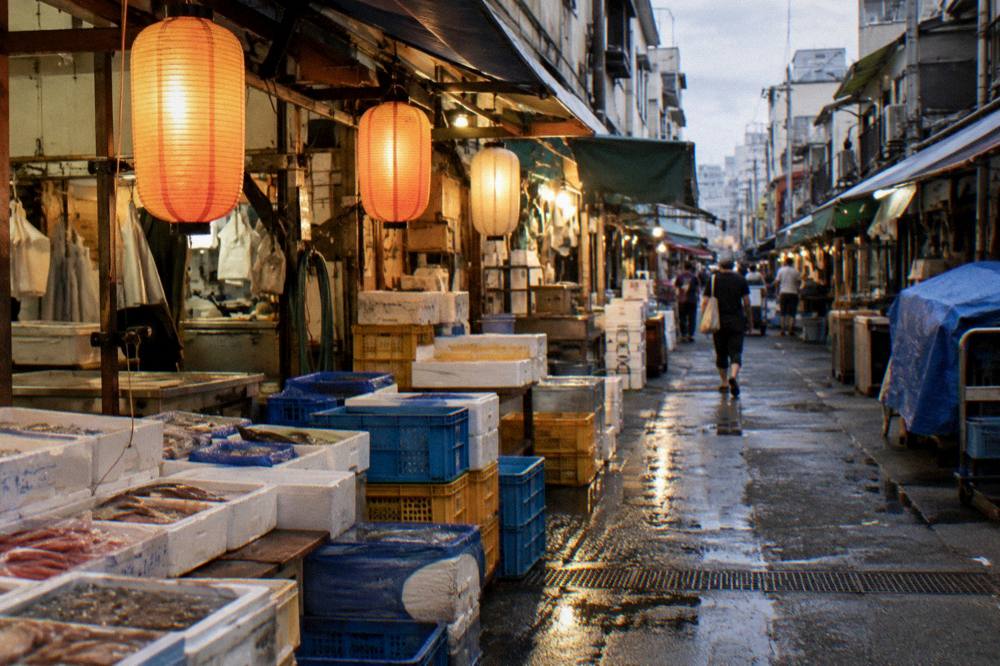
The market's own walk deserves the fullest description. The Tsukiji Street Food, 1h 30m walk, listed on GuruWalk and run by Local Guide Stars, is rated 4.88 out of 5 across 583 GuruWalk reviews, runs in English, and meets at Tsukiji Hongan-ji, at the stairs. Its guiding is free, pay what you want, while food on the walk is bought separately at the stalls, a split the walk's own listing makes clear. For a visitor who wants the market explained rather than just walked, it is the most direct option.
The Spanish language option reaches further. Tsukiji To Hamarikyu, 3 Hours, run by Ignacio on GuruWalk, is rated 4.93 out of 5 across 449 GuruWalk reviews, runs three hours in Spanish, and meets at Tsukiji before heading on toward the paid Hama-rikyu garden. It suits Spanish speakers building a longer morning, with the reminder that the garden's JPY 300 entry is a separate cost from the free guiding. The Tsukiji Sushi History walk, bilingual in English and Spanish and run by TokyoXplorers, has 10 GuruWalk reviews so far, in Spanish, too few for an overall score yet. It meets at Kachidoki Station, Exit A1, and is likewise free, pay what you want.
The palace connection is the interesting one for itinerary builders. The Palace Walk Ending At Tsukiji, run by Japan Navigators on GuruWalk and rated 4.84 out of 5 across 587 GuruWalk reviews, runs two hours in English and Spanish, starts at the Sakuradamon Gate of the Imperial Palace, and finishes at the market, which makes it a ready made free bridge between two of central Tokyo's free highlights. The palace end of that route is also covered in depth by the site's Imperial Palace guide.
| Walk | Platform | Meets at | Language | Duration | Rating |
|---|---|---|---|---|---|
| Tsukiji Street Food, 1h 30m | GuruWalk | Tsukiji Hongan-ji, Stairs | English | 1 hour 30 minutes | 4.88 out of 5, 583 reviews |
| Tsukiji To Hamarikyu, 3 Hours | GuruWalk | Tsukiji | Spanish | 3 hours | 4.93 out of 5, 449 reviews |
| Tsukiji Sushi History, Bilingual | GuruWalk | Kachidoki Station, Exit A1 | English and Spanish | 2 hours | 10 reviews, no score yet |
| Palace Walk Ending At Tsukiji | GuruWalk | Sakuradamon Gate, Imperial Palace | English and Spanish | 2 hours | 4.84 out of 5, 587 reviews |
A palace themed option with a different flavour is the Palace Storytelling Walk, run by 5 STORY on GuruWalk, rated 4.85 out of 5 across 901 GuruWalk reviews, a two hour English walk meeting at the Imperial Palace, Kokyogaien. It does not reach Tsukiji, but readers pairing the palace with the market on the same day often weigh it against the Japan Navigators walk above, and its review pool is the larger of the two. Choosing between them is a matter of language and ending point, since both are free, pay what you want and both are reserved through their own GuruWalk listings.
Beyond the market and the palace, the wider roster of 46 free walks on this site spreads across Asakusa, Shibuya, Shinjuku, Akihabara and quieter neighbourhoods, and the site's free walking tours overview lays out the full picture by district. Every one of them is free, pay what you want, reserved through its listing on GuruWalk, with the single exception of the Shimokitazawa walk listed on freetour.com. None carries a price, and none should be evaluated on anything but its rating, its language and its meeting point.
Mistakes That Trip People Up At Tsukiji Outer Market
The common mistakes are assuming the food is free like the entry, eating while walking against the official request, visiting in December during the New Year rush the market asks sightseers to avoid, confusing the free lanes with the paid gardens and museums nearby, and expecting a tour price where none exists. Each mistake comes from blurring the free and paid layers that sit side by side in this district.
The first mistake is the entry equals everything assumption. Free entry is real, but it buys the walk only, and visitors who arrive hungry without a food budget feel misled by a market that never promised anything else. The fix is mental: budget for Tsukiji as a meal with a free show attached, not as a free attraction with optional extras.
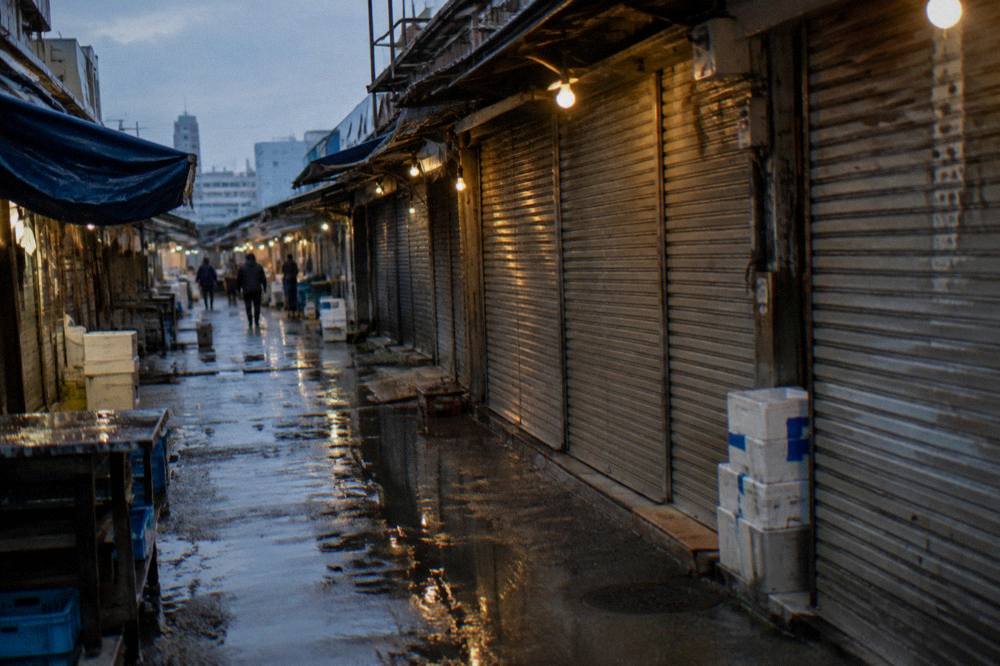
The second is ignoring the published etiquette. The rule is not arbitrary: the lanes are working retail routes, and a visitor eating on the move blocks them. Eating where you buy is the whole compliance, and it costs nothing.
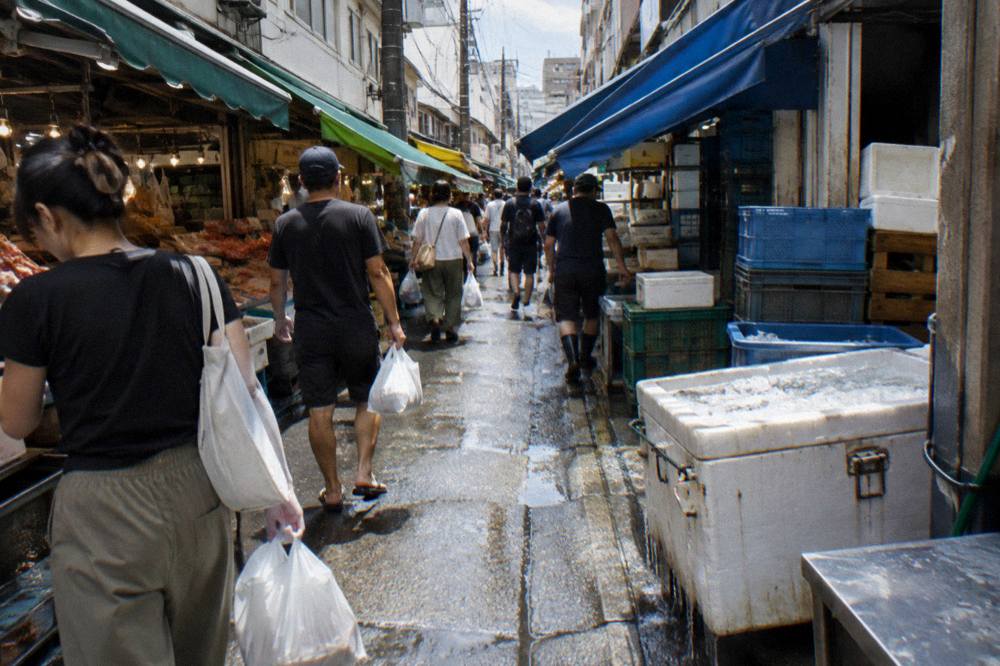
The third is the December visit. The official market asks sightseers and group tours to stay away during the New Year shopping rush, and a visitor who goes anyway is walking a lane built for commercial buyers rather than for them. December has plenty of other free Tokyo, from the Marunouchi Illumination along Naka-dori to the temple precincts that stay free all winter, and shifting the market to another month respects both the vendors and your own experience.
The fourth is the boundary mistake: treating the district as uniformly free. The lanes are free, the temple is free, but Hama-rikyu charges JPY 300, and the paid layers do not announce themselves with signs explaining the difference. The fifth mistake runs the other way: expecting a price on the guided walks. Every walk listed above is free, pay what you want, with food on the market walks bought separately, and a reader who goes looking for a ticket price will not find one because there is none.
Common Questions On This Topic
Is Tsukiji Outer Market Free To Enter?
Yes, completely. The lanes are a public shopping street with no gate, no ticket and no admission charge, and you can walk the whole market without spending anything. Food, drink, knives and souvenirs are paid at the stalls, but the walk itself is free.
Do You Have To Book To Walk Tsukiji Outer Market?
No. There is nothing to book and no capacity limit for an independent walk, since the market is an ordinary retail street. Booking only applies if you join one of the free, pay what you want guided walks, which are reserved through their listings on GuruWalk.
Is The Food At Tsukiji Outer Market Free?
No. Every stall, counter and restaurant charges for what it sells, and prices are set individually by the vendors. The guided Tsukiji Street Food walk is free, pay what you want for the guiding, but any food you eat on it is bought separately at the stalls.
Can You Eat While Walking At Tsukiji Outer Market?
The market's official site asks visitors not to eat while walking in the lanes. In practice that means eating at the stall where you bought the food or at a spot the vendor indicates.
Should You Visit Tsukiji Outer Market In December?
The market's official page asks sightseers and group tours to stay away in December, so plan your visit for another month.
Which Free Walking Tours Go To Tsukiji Outer Market?
Tsukiji Street Food, Tsukiji To Hamarikyu (in Spanish), Tsukiji Sushi History and the Palace Walk Ending At Tsukiji, which finishes in the market, are all free, pay what you want on GuruWalk, with food bought separately.